Medizinonline Medizinonline
  • News
    • News
    • Market & Medicine
  • Patients
    • Disease patterns
    • Diagnostics
    • Therapy
  • Partner Content
    • Diabetes
      • Dia-Month Club – Type 2 Diabetes
      • Diabetes in Motion
      • Diabetes Podcasts
    • Gastroenterology
      • IBD matters
    • Oncology
      • Swiss Oncology in motion
    • Orthopedics
      • Osteoporosis in motion
  • Departments
    • Allergology and clinical immunology
    • General Internal Medicine
    • Anesthesiology
    • Angiology
    • Surgery
    • Dermatology and venereology
    • Endocrinology and Diabetology
    • Nutrition
    • Gastroenterology and Hepatology
    • Genetics
    • Geriatrics
    • Gynecology
    • Hematology
    • Infectiology
    • Cardiology
    • Nephrology
    • Neurology
    • Emergency and intensive care medicine
    • Nuclear Medicine
    • Oncology
    • Ophthalmology
    • ORL
    • Orthopedics
    • Pediatrics
    • Pharmacology and toxicology
    • Pharmaceutical medicine
    • Phlebology
    • Physical medicine and rehabilitation
    • Pneumology
    • Prevention and health care
    • Psychiatry and psychotherapy
    • Radiology
    • Forensic Medicine
    • Rheumatology
    • Sports Medicine
    • Traumatology and trauma surgery
    • Tropical and travel medicine
    • Urology
    • Dentistry
  • CME & Congresses
    • CME continuing education
    • Congress Reports
    • Congress calendar
  • Practice
    • Noctimed
    • Practice Management
    • Jobs
    • Interviews
  • Log In
  • Register
  • My account
  • Contact
  • Publications
  • Contact
  • Deutsch
  • English
  • Français
  • Italiano
  • Português
  • Español
Subscribe
Medizinonline Medizinonline
  • News
    • News
    • Market & Medicine
  • Patienten
    • Krankheitsbilder
    • Diagnostik
    • Therapie
  • Partner Content
    • Diabetes
      • Dia-Month Club – Type 2 Diabetes
      • Diabetes in Motion
      • Diabetes Podcasts
    • Gastroenterology
      • IBD matters
    • Oncology
      • Swiss Oncology in motion
    • Orthopedics
      • Osteoporosis in motion
    • Phytotherapie
    • Rheumatology
  • Departments
    • Fachbereiche 1-13
      • Allergology and clinical immunology
      • General Internal Medicine
      • Anesthesiology
      • Angiology
      • Surgery
      • Dermatology and venereology
      • Endocrinology and Diabetology
      • Nutrition
      • Gastroenterology and Hepatology
      • Genetics
      • Geriatrics
      • Gynecology
      • Hematology
    • Fachbereiche 14-26
      • Infectiology
      • Cardiology
      • Nephrology
      • Neurology
      • Emergency and intensive care medicine
      • Nuclear Medicine
      • Oncology
      • Ophthalmology
      • ORL
      • Orthopedics
      • Pediatrics
      • Pharmacology and toxicology
      • Pharmaceutical medicine
    • Fachbereiche 26-38
      • Phlebology
      • Physical medicine and rehabilitation
      • Phytotherapy
      • Pneumology
      • Prevention and health care
      • Psychiatry and psychotherapy
      • Radiology
      • Forensic Medicine
      • Rheumatology
      • Sports Medicine
      • Traumatology and trauma surgery
      • Tropical and travel medicine
      • Urology
      • Dentistry
  • CME & Congresses
    • CME continuing education
    • Congress Reports
    • Congress calendar
  • Practice
    • Noctimed
    • Practice Management
    • Jobs
    • Interviews
Login

Sie haben noch keinen Account? Registrieren

  • Type 1 diabetics with insulin pumps when traveling by air

Changes in altitude can influence insulin delivery

    • RX
    • Congress Reports
    • Endocrinology and Diabetology
    • General Internal Medicine
    • Studies
    • Tropical and travel medicine
  • 3 minute read

Changes in flight altitude during commercial flights can affect the blood glucose levels of people with type 1 diabetes who are being treated with insulin pump therapy. This is according to new research presented at the European Association for the Study of Diabetes (EASD) 2024 Congress in Madrid.

When the altitude rises to around 30,000 feet, the cabin pressure is usually regulated automatically by the on-board computer. The maximum cabin pressure is around 7500 feet. However, the cabin pressure depends on the type of aircraft. It therefore varies: In older airplanes, the cabin pressure at cruising altitude is slightly higher and in newer airplanes slightly lower. For people with type 1 diabetes and an insulin pump, the changes in air pressure during the flight can affect the insulin delivery of the pumps and lead to unintended metabolic consequences.

Dr. Gerd Koehler, Department of Endocrinology and Diabetology, Medical University of Graz, Austria, presented the results of an in-vitro study in which the atmospheric changes during a commercial flight were simulated in a hypobaric chamber [1]. Insulin pumps from three different manufacturers were tested: 10 Medtronic 780G, 10 Tandem t:slim X2 and 6 Insulet Omnipod DASH.

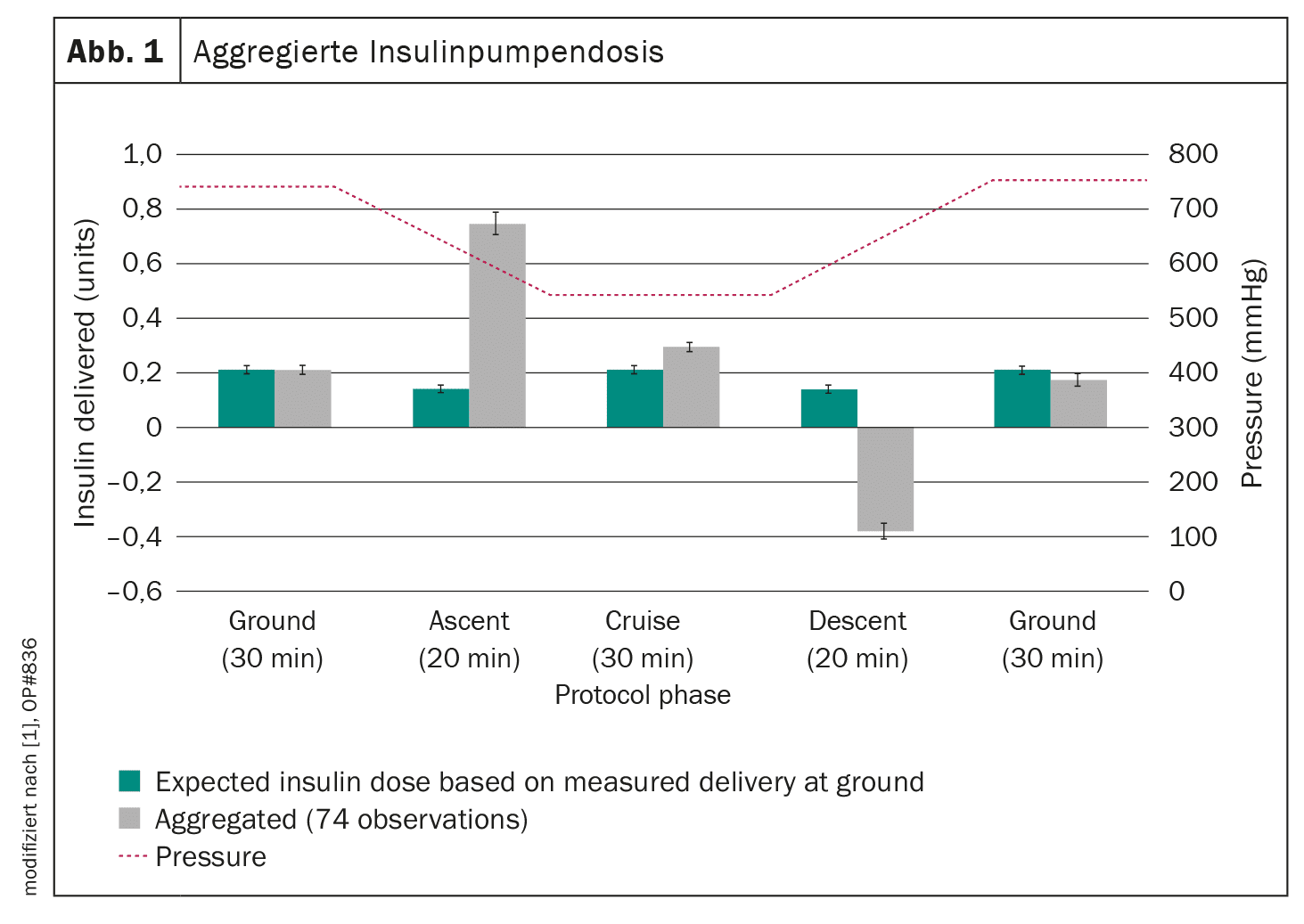
The pressure in the hypobaric chamber was lowered to 550 mmHg over a 20-minute ascent, maintained at this value during the 30-minute flight and then regulated to 750 mmHg (ground pressure) over a 20-minute descent ( Fig. 1). During the simulated flights, the insulin infusion was set to 0.6 units per hour to represent a rate used in adult and pediatric medicine and to allow accurate measurements over multiple flights.
Insulin delivery rates and bubble formation were recorded by attaching infusion sets to open 100-microliter capillary tubes on graph paper. Insulin infusion sets without pumps were also tested under a separate pressure protocol to simulate rapid decompression. This mimics the sudden loss of cabin pressure that occurs in emergencies.

0.60 units of insulin delivered too much

The researchers found that full insulin cartridges delivered 0.60 units of insulin too much during a 20-minute ascent (decrease in ambient pressure) compared to performance on the ground. While this may lead to a slight decrease in blood glucose levels, the authors do not believe that this would lead to clinically significant or symptomatic hypoglycemia.

On descent (increase in ambient pressure), the cartridges delivered 0.51 units of insulin too little. This can cause blood glucose levels to be higher than usual, but does not pose the same risk as the hypoglycemic effects of too high a dose of insulin.

What is striking, according to Dr. Köhler, is that the rapid decompression led to a fluid release equivalent to 5.6 units of excess insulin. In the rare case of sudden cabin decompression at high altitude, an insulin overdose could cause blood glucose levels to drop so low as to result in significant hypoglycemia. However, in such emergencies – for example, if an aircraft loses a door during flight – there would be time to consume additional short-acting carbohydrates to counteract this.

Source: Köhler G: Simulated commercial flights and the effects of atmospheric pressure changes on insulin pump delivery. Oral Presentation #836, Session SO 073: Diabetes technology – but at a higher Level. EASD, 10.09.2024.

Literature:

  1. Garden GL, et al: Effects of atmospheric pressure change during flight on insulin pump delivery and glycaemic Control of pilots with insulin-treated Diabetes: an in vitro Simulation and a retrospective observational real-world study. Diabetologia n.d.; in press.

InFo DIABETOLOGIE & ENDOKRINOLOGIE 2024; 1(4): 17 (published on 29.11.24, ahead of print)

Autoren
  • Jens Dehn
Publikation
  • InFo DIABETOLOGIE & ENDOKRINOLOGIE
Related Topics
  • Air travel
  • Flight altitude
  • Insulin pump
  • Insulin pumps
  • Pressure differences
  • T1D
  • Type 1 diabetes
Previous Article
  • Dementia

Current recommendations emphasize early detection and intervention

  • Neurology
  • Psychiatry and psychotherapy
  • RX
View Post
Next Article
  • Cystic fibrosis

Ageing as a new factor in care

  • Allergology and clinical immunology
  • Education
  • Genetics
  • Pediatrics
  • Pneumology
  • RX
  • Studies
View Post
You May Also Like
View Post
  • 13 min
  • Why lipoprotein(a) is the biggest therapeutic vacuum in cardiology

Lp(a): The underestimated risk factor before the turning point

    • Cardiology
    • Education
    • Endocrinology and Diabetology
    • RX
    • Studies
View Post
  • 11 min
  • Modern system therapeutics for hidradenitis suppurativa

Immunological dysregulation in the sights of several biologics and “small molecules”

    • Allergology and clinical immunology
    • Dermatology and venereology
    • Education
    • RX
    • Studies
View Post
  • 15 min
  • Perimenopausal depression, PMDS and tokophobia

Psychosomatics and mental health in gynecology

    • Education
    • Gynecology
    • Psychiatry and psychotherapy
    • RX
    • Studies
View Post
  • 8 min
  • Proteins in wound healing

Do special amino acids lead to success?

    • CME continuing education
    • Dermatology and venereology
    • Endocrinology and Diabetology
    • Nutrition
    • RX
    • Studies
View Post
  • 7 min
  • Plastic surgery and reconstructive microsurgery for DFS

Functional limb preservation between infection control, vascular medicine and resurfacing

    • Angiology
    • CME continuing education
    • Endocrinology and Diabetology
    • General Internal Medicine
    • Geriatrics
    • Physical medicine and rehabilitation
    • RX
    • Surgery
View Post
  • 9 min
  • Polycystic ovary syndrome 2025/2026

New pathophysiology, updated diagnostics and the age of incretin mimetics

    • Education
    • Gastroenterology and Hepatology
    • General Internal Medicine
    • Gynecology
    • Pharmacology and toxicology
    • RX
    • Studies
View Post
  • 14 min
  • Heart failure and type 2 diabetes

Oral semaglutide and cardiac decompensation in type 2 diabetes

    • Cardiology
    • Education
    • Endocrinology and Diabetology
    • RX
    • Studies
View Post
  • 7 min
  • Atopic dermatitis as a door opener for an atopic cascade?

AD trajectories: Summary of current findings

    • Allergology and clinical immunology
    • Congress Reports
    • Dermatology and venereology
    • RX
    • Studies
  • IBD matters

    Zum Thema
Top CME content
  • 1
    Functional limb preservation between infection control, vascular medicine and resurfacing
  • 2
    Do special amino acids lead to success?
  • 3
    Do special amino acids lead to success?
  • 4
    Current status of PAT
  • 5
    Surgical wound complications

Newsletter

Sign up and stay up to date

Subscribe
Medizinonline Medizinonline
  • Contact
  • General terms and conditions
  • Imprint

Input your search keywords and press Enter.