Medizinonline Medizinonline
  • News
    • News
    • Market & Medicine
  • Patients
    • Disease patterns
    • Diagnostics
    • Therapy
  • Partner Content
    • Diabetes
      • Dia-Month Club – Type 2 Diabetes
      • Diabetes in Motion
      • Diabetes Podcasts
    • Gastroenterology
      • IBD matters
    • Oncology
      • Swiss Oncology in motion
    • Orthopedics
      • Osteoporosis in motion
  • Departments
    • Allergology and clinical immunology
    • General Internal Medicine
    • Anesthesiology
    • Angiology
    • Surgery
    • Dermatology and venereology
    • Endocrinology and Diabetology
    • Nutrition
    • Gastroenterology and Hepatology
    • Genetics
    • Geriatrics
    • Gynecology
    • Hematology
    • Infectiology
    • Cardiology
    • Nephrology
    • Neurology
    • Emergency and intensive care medicine
    • Nuclear Medicine
    • Oncology
    • Ophthalmology
    • ORL
    • Orthopedics
    • Pediatrics
    • Pharmacology and toxicology
    • Pharmaceutical medicine
    • Phlebology
    • Physical medicine and rehabilitation
    • Pneumology
    • Prevention and health care
    • Psychiatry and psychotherapy
    • Radiology
    • Forensic Medicine
    • Rheumatology
    • Sports Medicine
    • Traumatology and trauma surgery
    • Tropical and travel medicine
    • Urology
    • Dentistry
  • CME & Congresses
    • CME continuing education
    • Congress Reports
    • Congress calendar
  • Practice
    • Noctimed
    • Practice Management
    • Jobs
    • Interviews
  • Log In
  • Register
  • My account
  • Contact
  • Publications
  • Contact
  • Deutsch
  • English
  • Français
  • Italiano
  • Português
  • Español
Subscribe
Medizinonline Medizinonline
  • News
    • News
    • Market & Medicine
  • Patienten
    • Krankheitsbilder
    • Diagnostik
    • Therapie
  • Partner Content
    • Diabetes
      • Dia-Month Club – Type 2 Diabetes
      • Diabetes in Motion
      • Diabetes Podcasts
    • Gastroenterology
      • IBD matters
    • Oncology
      • Swiss Oncology in motion
    • Orthopedics
      • Osteoporosis in motion
    • Phytotherapie
    • Rheumatology
  • Departments
    • Fachbereiche 1-13
      • Allergology and clinical immunology
      • General Internal Medicine
      • Anesthesiology
      • Angiology
      • Surgery
      • Dermatology and venereology
      • Endocrinology and Diabetology
      • Nutrition
      • Gastroenterology and Hepatology
      • Genetics
      • Geriatrics
      • Gynecology
      • Hematology
    • Fachbereiche 14-26
      • Infectiology
      • Cardiology
      • Nephrology
      • Neurology
      • Emergency and intensive care medicine
      • Nuclear Medicine
      • Oncology
      • Ophthalmology
      • ORL
      • Orthopedics
      • Pediatrics
      • Pharmacology and toxicology
      • Pharmaceutical medicine
    • Fachbereiche 26-38
      • Phlebology
      • Physical medicine and rehabilitation
      • Phytotherapy
      • Pneumology
      • Prevention and health care
      • Psychiatry and psychotherapy
      • Radiology
      • Forensic Medicine
      • Rheumatology
      • Sports Medicine
      • Traumatology and trauma surgery
      • Tropical and travel medicine
      • Urology
      • Dentistry
  • CME & Congresses
    • CME continuing education
    • Congress Reports
    • Congress calendar
  • Practice
    • Noctimed
    • Practice Management
    • Jobs
    • Interviews
Login

Sie haben noch keinen Account? Registrieren

  • Colonoscopy

Intestinal cleansing recommended in stages

    • Education
    • Gastroenterology and Hepatology
    • General Internal Medicine
    • Prevention and health care
    • RX
    • Studies
  • 3 minute read

To best prepare the bowel for colonoscopy, bowel cleansing is essential. This is because an optimal view of the intestinal mucosa is only guaranteed if the bowel is clean, so that even small tissue changes can be detected. Scientific studies show that taking laxatives spread over two days offers advantages compared to the total dose on the day before endoscopy.

Colonoscopy is the gold standard for early detection of colorectal cancer. A variety of preparations are available for colon cleansing, with polyethylene glycol (PEG) and sodium phosphate (NaP) solutions being the most commonly used. Ideally, little residual fluid and no residual stool remain in the colon after a bowel cleansing, so that a reliable assessment of the intestinal mucosa is possible. Either the intake of the laxative can be split between administering the first dose the day before and the second dose on the morning of the colonoscopy day (“splitting regimen”) or the entire dose is taken the day before.

In several studies, a “splitting regime” proved to be beneficial

In a meta-analysis by Martel et al. the overall rate of successful bowel preparation was more than doubled with two days of intake compared to one day of intake (OR 2.51; 95% CI 1.46-4.63) [1].(Table 1). The researchers explain the superiority of the splitting regimen by the fact that with two-part administration, the time between taking the last dose of the laxative and the colonoscopy is shortened. In most studies, the drug was taken between 5 and 6 am. The results of the meta-analysis published in 2015 are still relevant. For example, a review by a British research team published in the BMJ Open Gastroenterology in 2021 also points out that the so-called “run-way time”, i.e. the time between administration of the last dose of bowel preparation until colonoscopy, is crucial [2]. That a prolonged “run-way time” is associated with a reduction in the proportion of patients with a good or very good bowel cleansing result was empirically demonstrated in a previous study [3].
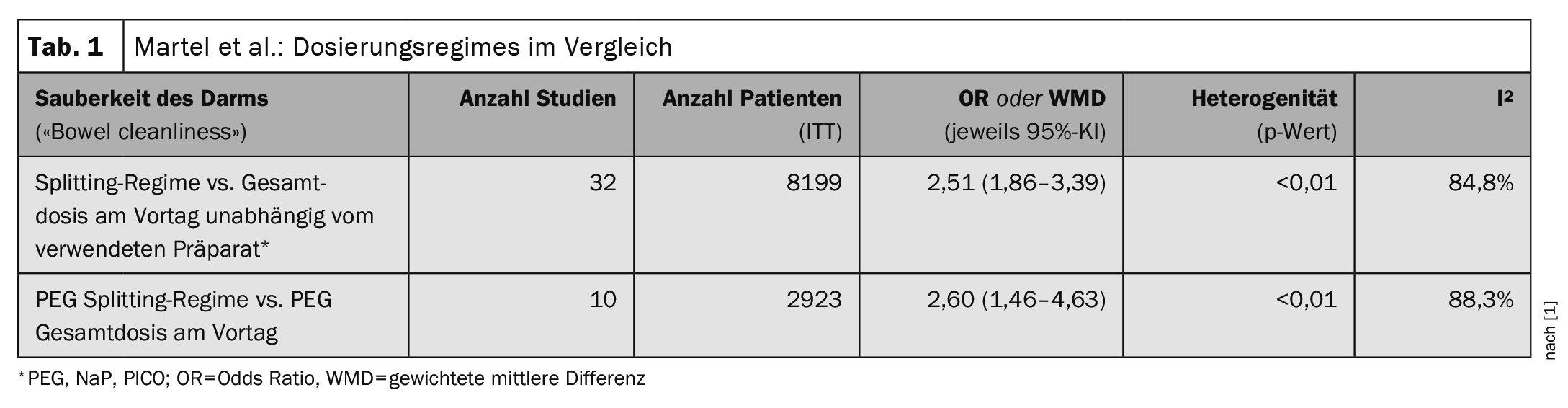
The splitting regimen also showed improvement in terms of patient satisfaction in the meta-analysis by Martel et al. clear advantages. Thus, the willingness to undergo a corresponding procedure again was significantly higher with two-part administration. With regard to the detection of polyps or adenomas, no significant advantages or disadvantages of any regimen could be demonstrated, as the authors point out, although only two studies were evaluated for this question [4].

In any case, it is very important that patients adhere to the colon cleansing protocol that they receive in advance of the colonoscopy. Preparatory measures also include not eating solid food after taking the laxatives. A short reminder the day before can help patients to implement this accordingly. Foods such as whole-grain bread, cereals, grapes, tomatoes, nuts, poppy seeds or kiwi should also be avoided for up to four days before the examination to prevent seeds from clogging the endoscope.

Literature:

  1. Martel M, et al: Split-Dose Preparations Are Superior to Day-Before Bowel Cleansing Regimens: A Meta-analysis. Gastroenterology 2015; 149(1): 79-88.
  2. Archer T, et al: Is it time we split bowel preparation for all colonoscopies? Outcomes from a national survey of bowel preparation practice in the UK. BMJ Open Gastroenterol 2021; 8(1): e000736.
  3. Siddiqui AA, et al: Duration of the interval between the completion of bowel preparation and the start of colonoscopy predicts bowel-preparation quality. Gastrointest Endosc 2009; 69(3 Pt 2): 700-706.
  4. “Before colonoscopy, bowel cleansing better spread over two days,” www.aerztezeitung.de/Medizin/Darmreinigung-besser-auf-zwei-Tage-verteilen-249012.html,(last accessed Jan. 10, 2023).


HAUSARZT PRAXIS 2023; 18(1): 22

Autoren
  • Mirjam Peter, M.Sc.
Publikation
  • HAUSARZT PRAXIS
Related Topics
  • colonoscopy
  • Colonoscopy
  • endoscopy
  • Gastric mucosa
  • Intestinal cleansing
  • intestinal mucosa
  • Stages
Previous Article
  • Case study from the clinic

Atypical dermal melanocytosis

  • Cases
  • Congress Reports
  • Dermatology and venereology
  • Education
  • General Internal Medicine
  • Genetics
  • Pediatrics
  • RX
View Post
Next Article
  • Pyoderma gangraenosum

Extremely painful ulcerations with systemic inflammatory component

  • Congress Reports
  • Dermatology and venereology
  • Education
  • Gastroenterology and Hepatology
  • General Internal Medicine
  • Geriatrics
  • Physical medicine and rehabilitation
  • Prevention and health care
  • Rheumatology
View Post
You May Also Like
View Post
  • 8 min
  • Proteins in wound healing

Do special amino acids lead to success?

    • CME continuing education
    • Dermatology and venereology
    • Endocrinology and Diabetology
    • Nutrition
    • RX
    • Studies
View Post
  • 5 min
  • Case study

Autosomal recessive polycystic kidney disease: atypical phenotype

    • Cases
    • Education
    • Gastroenterology and Hepatology
    • Genetics
    • Nephrology
    • RX
View Post
  • 12 min
  • Current evidence, risk classes and new counseling options

Hormonal contraception and cardiovascular risk

    • Cardiology
    • Education
    • Gynecology
    • Neurology
    • Pharmacology and toxicology
    • RX
    • Studies
View Post
  • 4 min
  • Acute otitis media: self-limiting course vs. "red flags"

In which cases are antibiotics necessary?

    • Congress Reports
    • General Internal Medicine
    • Infectiology
    • ORL
    • Pediatrics
    • RX
View Post
  • 6 min
  • Prurigo nodularis: evidence-based treatment

Targeted therapy options on the rise

    • Allergology and clinical immunology
    • Dermatology and venereology
    • Education
    • Pharmacology and toxicology
    • RX
    • Studies
View Post
  • 13 min
  • MACE risk, heart failure incidence and all-cause mortality

Metabolic syndrome as a cardiovascular risk factor

    • Cardiology
    • Education
    • Endocrinology and Diabetology
    • General Internal Medicine
    • RX
    • Studies
View Post
  • 9 min
  • Glaucoma in old age: slowing down progression

IOP lowering is currently the only evidence-based treatment

    • Education
    • General Internal Medicine
    • Ophthalmology
    • Prevention and health care
    • RX
    • Studies
View Post
  • 7 min
  • Vector-borne infections with skin manifestations

Arboviruses and leishmaniasis in Europe

    • Congress Reports
    • Infectiology
    • Prevention and health care
    • RX
    • Studies
    • Tropical and travel medicine
  • IBD matters

    Zum Thema
Top CME content
  • 1
    Do special amino acids lead to success?
  • 2
    Current status of PAT
  • 3
    Surgical wound complications
  • 4
    Do special amino acids lead to success?
  • 5
    Functional limb preservation between infection control, vascular medicine and resurfacing

Newsletter

Sign up and stay up to date

Subscribe
Medizinonline Medizinonline
  • Contact
  • General terms and conditions
  • Imprint

Input your search keywords and press Enter.