Medizinonline Medizinonline
  • News
    • News
    • Market & Medicine
  • Patients
    • Disease patterns
    • Diagnostics
    • Therapy
  • Partner Content
    • Diabetes
      • Dia-Month Club – Type 2 Diabetes
      • Diabetes in Motion
      • Diabetes Podcasts
    • Gastroenterology
      • IBD matters
    • Oncology
      • Swiss Oncology in motion
    • Orthopedics
      • Osteoporosis in motion
  • Departments
    • Allergology and clinical immunology
    • General Internal Medicine
    • Anesthesiology
    • Angiology
    • Surgery
    • Dermatology and venereology
    • Endocrinology and Diabetology
    • Nutrition
    • Gastroenterology and Hepatology
    • Genetics
    • Geriatrics
    • Gynecology
    • Hematology
    • Infectiology
    • Cardiology
    • Nephrology
    • Neurology
    • Emergency and intensive care medicine
    • Nuclear Medicine
    • Oncology
    • Ophthalmology
    • ORL
    • Orthopedics
    • Pediatrics
    • Pharmacology and toxicology
    • Pharmaceutical medicine
    • Phlebology
    • Physical medicine and rehabilitation
    • Pneumology
    • Prevention and health care
    • Psychiatry and psychotherapy
    • Radiology
    • Forensic Medicine
    • Rheumatology
    • Sports Medicine
    • Traumatology and trauma surgery
    • Tropical and travel medicine
    • Urology
    • Dentistry
  • CME & Congresses
    • CME continuing education
    • Congress Reports
    • Congress calendar
  • Practice
    • Noctimed
    • Practice Management
    • Jobs
    • Interviews
  • Log In
  • Register
  • My account
  • Contact
  • Publications
  • Contact
  • Deutsch
  • English
  • Français
  • Italiano
  • Português
  • Español
Subscribe
Medizinonline Medizinonline
  • News
    • News
    • Market & Medicine
  • Patienten
    • Krankheitsbilder
    • Diagnostik
    • Therapie
  • Partner Content
    • Diabetes
      • Dia-Month Club – Type 2 Diabetes
      • Diabetes in Motion
      • Diabetes Podcasts
    • Gastroenterology
      • IBD matters
    • Oncology
      • Swiss Oncology in motion
    • Orthopedics
      • Osteoporosis in motion
    • Phytotherapie
    • Rheumatology
  • Departments
    • Fachbereiche 1-13
      • Allergology and clinical immunology
      • General Internal Medicine
      • Anesthesiology
      • Angiology
      • Surgery
      • Dermatology and venereology
      • Endocrinology and Diabetology
      • Nutrition
      • Gastroenterology and Hepatology
      • Genetics
      • Geriatrics
      • Gynecology
      • Hematology
    • Fachbereiche 14-26
      • Infectiology
      • Cardiology
      • Nephrology
      • Neurology
      • Emergency and intensive care medicine
      • Nuclear Medicine
      • Oncology
      • Ophthalmology
      • ORL
      • Orthopedics
      • Pediatrics
      • Pharmacology and toxicology
      • Pharmaceutical medicine
    • Fachbereiche 26-38
      • Phlebology
      • Physical medicine and rehabilitation
      • Phytotherapy
      • Pneumology
      • Prevention and health care
      • Psychiatry and psychotherapy
      • Radiology
      • Forensic Medicine
      • Rheumatology
      • Sports Medicine
      • Traumatology and trauma surgery
      • Tropical and travel medicine
      • Urology
      • Dentistry
  • CME & Congresses
    • CME continuing education
    • Congress Reports
    • Congress calendar
  • Practice
    • Noctimed
    • Practice Management
    • Jobs
    • Interviews
Login

Sie haben noch keinen Account? Registrieren

  • Oral anticoagulation

New brooms sweep better!?

    • Cardiology
    • Congress Reports
    • RX
  • 3 minute read

In nonvalvular atrial fibrillation, treatment with oral anticoagulants is indicated. Many guidelines recommend the use of direct oral anticoagulants (DOAK) as first-line therapy. The advantage here is considered to be the elimination of regular INR monitoring and the ease of setting management. But is “one-dose-fits-all” really preferable?

Vitamin K antagonists (VKA) have been available for the prophylaxis of thromboembolic complications for about 50 years. They are used for oral anticoagulation for an artificial heart valve, atrial fibrillation or thrombophilia. With the introduction of DOAKs, the therapeutic options for anticoagulation have been expanded. This is also reflected in the frequency of prescriptions, which has increased significantly in recent years, especially for thrombin and factor Xa antagonists, as Prof. Heiner K. Berthold, MD, Bielefeld, Germany, explained.  This development is also reflected in the guidelines, which predominantly recommend the preferred use of DOAKs. Not so, however, the Drug Commission of the German Medical Association (AkdÄ). It argues for preferential use of VKAs.

“There are definitely many advantages to using VKAs,” the expert said. This includes, for example, complete transparency about the potency and all influencing factors, as these are reflected in the INR. Through regular measurement, comedications, nutrition or even liver and kidney function can be monitored. Adherence can also be well monitored via INR measurement. “Once patients are well adjusted, they are easy to manage for years,” Berthold affirmed. This is sometimes due to the complexity of the active ingredients occurring at different times. While VKAs usually require intensive monitoring during the first four weeks of discontinuation, the complexity of DOAKs emerges over time. This may have implications for the kidneys, comedication, and in interventions. By closely monitoring INR during VKA therapy, the degree of anticoagulation can be monitored and a rapid response can be made if necessary.

Real-life data show superiority

Recent study results now also demonstrate significant superiority of VKAs over DOAKs [1]. The aim was to compare real-world data on efficacy and safety of the two therapeutic approaches in patients with atrial fibrillation. For this purpose, insurance data were analyzed from 11.1 million patients who had AF and whose diagnosis was confirmed by at least two outpatient diagnoses and/or a clinical diagnosis. They had received at least one outpatient prescription for a DOAK or VKA and had a CHA2DS2VAScscore >1 in the year before the initial prescription.

Two equally sized cohorts of 37,439 patients each with equivalent risk profiles were included in the analysis. The mean age was 78 years and the mean follow-up period was 12 months. It was shown that in almost every outcome parameter significantly more events occurred under DOAK therapy than under VKA (Fig. 1). Only hemorrhagic stroke was comparable in both groups.
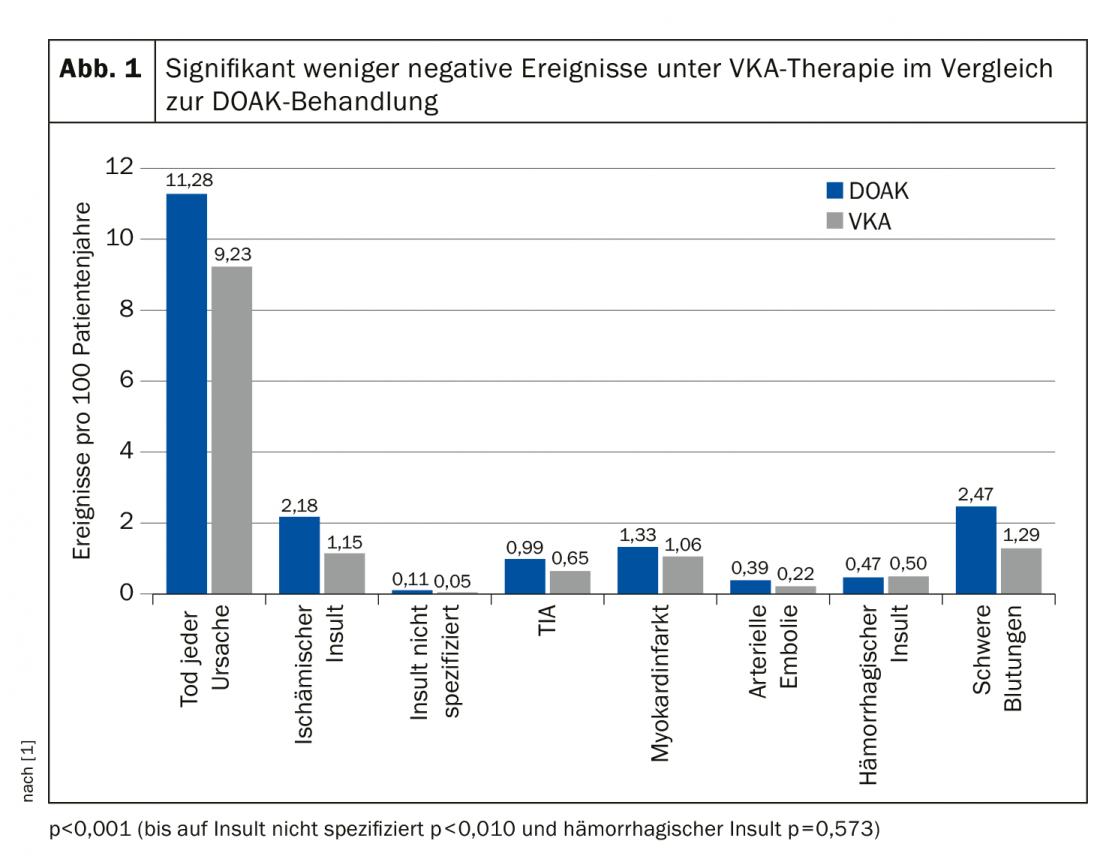


The quality of adjustment with VKA therapy seems to be very good, whereas that of DOAK administration is seen more critically by the authors. This is because about half of all patients received only low-dose therapy, even though there was often no diagnosis of renal insufficiency or failure. Accordingly, the optimum dosage was not achieved. In everyday practice, therefore, VKA therapy appears to be the more effective and safer choice.

Source: DGIM 2019, Wiesbaden (D)


Literature:

  1. Müller S, et al: Real-world effectiveness and safety of oral anticoagulation strategies in atrial fibrillation: a cohort study based on a German claims dataset. Pragmatic and Observational Research 2018; 9: 1-10.

HAUSARZT PRAXIS 2019; 14(9): 26 (published 9/30/19, ahead of print).
Publikation
  • HAUSARZT PRAXIS
Related Topics
  • Anticoagulation
  • Atrial fibrillation
  • DOAK
  • VKA
Previous Article
  • Psoriasis capitis

The world of topical therapy

  • Dermatology and venereology
  • Education
  • RX
View Post
Next Article
  • Tumor-associated thromboembolism

Oral anticoagulation with NOAKs?

  • Cardiology
  • News
  • Oncology
  • RX
View Post
You May Also Like
View Post
  • 4 min
  • GLP1 receptor agonists

Positive influence on substance use and addiction

    • Education
    • Endocrinology and Diabetology
    • General Internal Medicine
    • RX
    • Studies
View Post
  • 11 min
  • Sleep apnea and cardiovascular diseases

Breathless through the night

    • Cardiology
    • Education
    • General Internal Medicine
    • ORL
    • Pneumology
    • RX
    • Studies
View Post
  • 15 min
  • Diagnostics, differentiation and multimodal therapy

Vulvar diseases and vulvodynia

    • Dermatology and venereology
    • Education
    • Gynecology
    • Infectiology
    • RX
    • Studies
View Post
  • 3 min
  • From symptom to diagnosis

Abdominal pain – Prostate lipoma

    • Cases
    • Education
    • General Internal Medicine
    • Radiology
    • RX
    • Surgery
    • Urology
View Post
  • 6 min
  • Acute pulmonary embolism: new AHA/ACC guideline

Practical recommendations for risk-stratified triage

    • Cardiology
    • Education
    • Pneumology
    • RX
    • Studies
View Post
  • 13 min
  • Why lipoprotein(a) is the biggest therapeutic vacuum in cardiology

Lp(a): The underestimated risk factor before the turning point

    • Cardiology
    • Education
    • Endocrinology and Diabetology
    • RX
    • Studies
View Post
  • 11 min
  • Modern system therapeutics for hidradenitis suppurativa

Immunological dysregulation in the sights of several biologics and “small molecules”

    • Allergology and clinical immunology
    • Dermatology and venereology
    • Education
    • RX
    • Studies
View Post
  • 15 min
  • Perimenopausal depression, PMDS and tokophobia

Psychosomatics and mental health in gynecology

    • Education
    • Gynecology
    • Psychiatry and psychotherapy
    • RX
    • Studies
  • IBD matters

    Zum Thema
Top CME content
  • 1
    Functional limb preservation between infection control, vascular medicine and resurfacing
  • 2
    Do special amino acids lead to success?
  • 3
    Do special amino acids lead to success?
  • 4
    Current status of PAT
  • 5
    Surgical wound complications

Newsletter

Sign up and stay up to date

Subscribe
Medizinonline Medizinonline
  • Contact
  • General terms and conditions
  • Imprint

Input your search keywords and press Enter.