Medizinonline Medizinonline
  • News
    • News
    • Market & Medicine
  • Patients
    • Disease patterns
    • Diagnostics
    • Therapy
  • Partner Content
    • Dermatology
      • Atopic dermatitis and psoriasis news
    • Diabetes
      • Dia-Month Club – Type 2 Diabetes
      • Diabetes in Motion
      • Diabetes Podcasts
    • Gastroenterology
      • IBD matters
    • Oncology
      • Swiss Oncology in motion
    • Orthopedics
      • Osteoporosis in motion
  • Departments
    • Allergology and clinical immunology
    • General Internal Medicine
    • Anesthesiology
    • Angiology
    • Surgery
    • Dermatology and venereology
    • Endocrinology and Diabetology
    • Nutrition
    • Gastroenterology and Hepatology
    • Genetics
    • Geriatrics
    • Gynecology
    • Hematology
    • Infectiology
    • Cardiology
    • Nephrology
    • Neurology
    • Emergency and intensive care medicine
    • Nuclear Medicine
    • Oncology
    • Ophthalmology
    • ORL
    • Orthopedics
    • Pediatrics
    • Pharmacology and toxicology
    • Pharmaceutical medicine
    • Phlebology
    • Physical medicine and rehabilitation
    • Pneumology
    • Prevention and health care
    • Psychiatry and psychotherapy
    • Radiology
    • Forensic Medicine
    • Rheumatology
    • Sports Medicine
    • Traumatology and trauma surgery
    • Tropical and travel medicine
    • Urology
    • Dentistry
  • CME & Congresses
    • CME continuing education
    • Congress Reports
    • Congress calendar
  • Practice
    • Noctimed
    • Practice Management
    • Jobs
    • Interviews
  • Log In
  • Register
  • My account
  • Contact
  • Publications
  • Contact
  • Deutsch
  • English
  • Français
  • Italiano
  • Português
  • Español
Subscribe
Medizinonline Medizinonline
  • News
    • News
    • Market & Medicine
  • Patienten
    • Krankheitsbilder
    • Diagnostik
    • Therapie
  • Partner Content
    • Dermatology
      • Atopic dermatitis and psoriasis news
    • Diabetes
      • Dia-Month Club – Type 2 Diabetes
      • Diabetes in Motion
      • Diabetes Podcasts
    • Gastroenterology
      • IBD matters
    • Oncology
      • Swiss Oncology in motion
    • Orthopedics
      • Osteoporosis in motion
    • Phytotherapie
    • Rheumatology
  • Departments
    • Fachbereiche 1-13
      • Allergology and clinical immunology
      • General Internal Medicine
      • Anesthesiology
      • Angiology
      • Surgery
      • Dermatology and venereology
      • Endocrinology and Diabetology
      • Nutrition
      • Gastroenterology and Hepatology
      • Genetics
      • Geriatrics
      • Gynecology
      • Hematology
    • Fachbereiche 14-26
      • Infectiology
      • Cardiology
      • Nephrology
      • Neurology
      • Emergency and intensive care medicine
      • Nuclear Medicine
      • Oncology
      • Ophthalmology
      • ORL
      • Orthopedics
      • Pediatrics
      • Pharmacology and toxicology
      • Pharmaceutical medicine
    • Fachbereiche 26-38
      • Phlebology
      • Physical medicine and rehabilitation
      • Phytotherapy
      • Pneumology
      • Prevention and health care
      • Psychiatry and psychotherapy
      • Radiology
      • Forensic Medicine
      • Rheumatology
      • Sports Medicine
      • Traumatology and trauma surgery
      • Tropical and travel medicine
      • Urology
      • Dentistry
  • CME & Congresses
    • CME continuing education
    • Congress Reports
    • Congress calendar
  • Practice
    • Noctimed
    • Practice Management
    • Jobs
    • Interviews
Login

Sie haben noch keinen Account? Registrieren

  • Acne

The most common dermatological disease under the magnifying glass

    • Allergology and clinical immunology
    • Dermatology and venereology
    • RX
  • 3 minute read

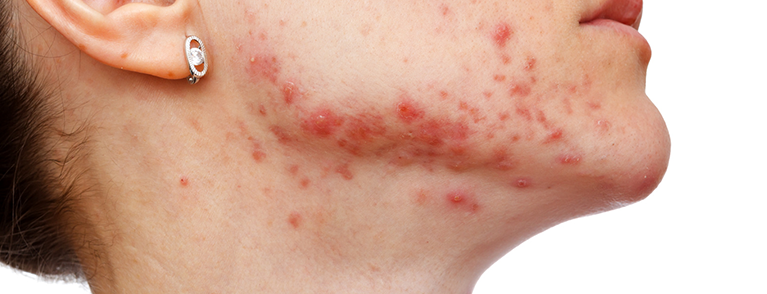
Many see acne as a necessary evil of puberty, which recedes at a later stage of life without further consequences. It is forgotten that the disease can occur at very different stages of life and, due to its duration and severity, requires treatment in up to 30% of those affected. Because acne is so common, there is a great demand for effective treatments that reduce the suffering of this disease, which should not be underestimated. Oral isotretinoin is a very good treatment option for severe, refractory forms, but it should not be prescribed lightly because of the numerous side effects.

(ag) Acne is the most common dermatological disease worldwide [1]. It manifests itself in diverse clinical manifestations and is a problem not only in adolescents (up to 95% suffer from acne lesions according to studies [2]), but in very different stages of life. Nevertheless, the disease has its maximum incidence between the ages of 15 and 18 and regresses spontaneously in the vast majority of affected individuals after puberty (although not infrequently with serious scarring). Mostly the face and the upper trunk area are affected. Although the prevalence is slightly higher in men and often acne has a higher severity in this population, it persists after the age of 20 predominantly in women [3–5].

Pathogenesis

15-30% of patients require medical therapy due to the duration of the disease or severity. For targeted symptomatic or even etiologic therapy, a precise knowledge of the origin is necessary.
Traditionally, factors thought to be involved in acne development include:

  • Increased activity of the sebaceous glands with seborrhea
  • Impaired follicular differentiation and increased keratinization
  • Microbial hypercolonization
  • Inflammatory responses with the respective immunological processes [6].

Today’s knowledge has broadened the etiological concept, especially hereditary factors, but also the influence of menstruation (irregular cycle) or pregnancy as well as nutritional and environmental influences are discussed. Numerous medications can trigger or exacerbate acne [5].

Isotretinoin in the treatment of acne

Isotretinoin is a naturally occurring vitamin A derivative. As the only substance, systemic isotretinoin influences all pathogenetic factors of acne (directly or indirectly). The comedogenesis and indirectly the bacterial count are reduced, the size of the sebaceous glands (by up to 90%) as well as the sebum production and the inflammatory reaction are reduced [5]. According to recent data, isotretinoin also influences the normalization and reconstruction of dermal tissue through its effect on matrix metalloproteinases and their specific inhibitors (“tissue inhibitors of metalloproteinases”, TIMP) [7].

With regard to sebosuppression, oral isotretinoin is the most effective drug; one can speak of an actual revolution in the therapy of severe forms of acne [5].

Indication: Oral isotretinoin may only be used in severe acne resistant to adequate standard therapy (with systemic antibiotics and topical therapy) [8].

Contraindications: The drug is teratogenic.Important contraindication is therefore pregnancy, because during and one month after treatment there is a great risk of severe fetal malformations [5,8].

Teratogenicity: Teratogenicity, by far the most significant of all side effects, was discovered shortly after the drug was introduced. Safe conception protection (one month before, during and after treatment) and documentation by pregnancy test are therefore absolutely essential. If compliance, understanding and knowledge of the side effects or risk, and absolute reliability cannot be assured in the patient, the agent is contraindicated in women of childbearing age. Also, the patient must agree to be examined immediately if pregnancy has possibly occurred. The requirements apply equally to women who state that they are not currently sexually active. Written informed consent is recommended [8].

Interactions: Co-medication with vitamin A increases toxicity, tetracyclines may cause intracranial pressure increase. Types of peeling and depilation using wax on the face should be avoided during and up to six months after therapy [5,8].

Literature:

  1. Zouboulis CC: Acne and sebaceous gland function. Clin Dermatol. 2004; 22: 360-366.
  2. Ghodsi SZ, Orawa H, Zouboulis CC: Prevalence, severity, and severity risk factors of acne in high school pupils: a community-based study . J Invest Dermatol 2009; 129: 2136-2141.
  3. Cunliffe WJ, Gould DJ: Prevalence of facial acne vulgaris in late adolescence and in adults. Br Med J 1979; 1: 1109-1110.
  4. Poli F, Dreno B, Verschoore M: An epidemiological study of acne in female adults: results of a survey conducted in France. J Eur Acad Dermatol Venereol 2001; 15: 541-545.
  5. AWMF online: Treatment of acne. Corrected version 10/2011. www. awmf.org/uploads/tx_szleitlinien/ 013-017l_S2k_Treatment_of_Acne_2011-10-Correction.pdf.
  6. Zouboulis CC, et al: What is the pathogenesis of acne? Exp Dermatol 2005; 14: 143-152.
  7. Papakonstantinou E, et al: Matrixmetalloproteinases of epithelial origin in facial sebum of patients with acne and their regulation by isotretinoin. J Invest Dermatol 2005; 125: 673-684.
  8. Tretinac® drug information: www.swissmedicinfo.ch

DERMATOLOGIE PRAXIS 2014; 24(2): 34-36

Autoren
  • Andreas Grossmann
Publikation
  • DERMATOLOGIE PRAXIS
Related Topics
  • Acne
  • Isotretinoin
  • Puberty
  • vitamin A
Previous Article
  • Direct oral anticoagulants

“Teaching Old Docs New Tricks?”

  • Cardiology
  • News
  • RX
View Post
Next Article
  • Arthroscopic knee surgery

A process under the microscope

  • Education
  • Orthopedics
  • RX
  • Studies
  • Surgery
View Post
You May Also Like
View Post
  • 6 min
  • Abdominal aortic aneurysms in primary care

Risk-stratified screening and prophylaxis

    • Angiology
    • Congress Reports
    • Prevention and health care
    • Radiology
    • RX
    • Studies
    • Surgery
View Post
  • 9 min
  • Cardiology

Minimally invasive – the quiet triumph of modern heart surgery

    • Cardiology
    • CME continuing education
    • RX
    • Studies
    • Surgery
View Post
  • 0 min
  • Plastic surgery and reconstructive microsurgery for DFS

Functional limb preservation between infection control, vascular medicine and resurfacing

    • Angiology
    • CME continuing education
    • Endocrinology and Diabetology
    • General Internal Medicine
    • Geriatrics
    • Physical medicine and rehabilitation
    • RX
    • Surgery
View Post
  • 6 min
  • Age-related neurocognitive disorders

Neuroprotective effects of Ginkgo biloba extract

    • Education
    • Geriatrics
    • Neurology
    • Pharmaceutical medicine
    • Phytotherapy
    • RX
    • Studies
View Post
  • 6 min
    • Education
    • Endocrinology and Diabetology
    • Pneumology
    • Psychiatry and psychotherapy
    • RX
    • Studies

How origin and place of residence promote CF-associated diabetes

View Post
  • 10 min
  • Patients with leg swelling

DVT and other common DDs with peripheral edema

    • Angiology
    • Cardiology
    • Congress Reports
    • Geriatrics
    • RX
View Post
  • 4 min
  • Pancreatic Cancer

Innovative early detection with a focus on liquid biopsy and AI

    • Education
    • Gastroenterology and Hepatology
    • Oncology
    • Prevention and health care
    • RX
View Post
  • 22 min
  • Cervical Cancer

HPV prevention, screening innovation and sentinel lymph node biopsy

    • CME continuing education
    • Gynecology
    • Infectiology
    • Oncology
    • Prevention and health care
    • RX
    • Studies
  • IBD matters

    Zum Thema
Top CME content
  • 1
    Functional limb preservation between infection control, vascular medicine and resurfacing
  • 2
    Minimally invasive – the quiet triumph of modern heart surgery
  • 3
    HPV prevention, screening innovation and sentinel lymph node biopsy
  • 4
    Clinical care from birth to adulthood
  • 5
    Multidisciplinary teams in oncology

Newsletter

Sign up and stay up to date

Subscribe
Medizinonline Medizinonline
  • Contact
  • General terms and conditions
  • Imprint

Input your search keywords and press Enter.