Medizinonline Medizinonline
  • News
    • News
    • Market & Medicine
  • Patients
    • Disease patterns
    • Diagnostics
    • Therapy
  • Partner Content
    • Dermatology
      • Atopic dermatitis and psoriasis news
    • Diabetes
      • Dia-Month Club – Type 2 Diabetes
      • Diabetes in Motion
      • Diabetes Podcasts
    • Gastroenterology
      • IBD matters
    • Oncology
      • Swiss Oncology in motion
    • Orthopedics
      • Osteoporosis in motion
  • Departments
    • Allergology and clinical immunology
    • General Internal Medicine
    • Anesthesiology
    • Angiology
    • Surgery
    • Dermatology and venereology
    • Endocrinology and Diabetology
    • Nutrition
    • Gastroenterology and Hepatology
    • Genetics
    • Geriatrics
    • Gynecology
    • Hematology
    • Infectiology
    • Cardiology
    • Nephrology
    • Neurology
    • Emergency and intensive care medicine
    • Nuclear Medicine
    • Oncology
    • Ophthalmology
    • ORL
    • Orthopedics
    • Pediatrics
    • Pharmacology and toxicology
    • Pharmaceutical medicine
    • Phlebology
    • Physical medicine and rehabilitation
    • Pneumology
    • Prevention and health care
    • Psychiatry and psychotherapy
    • Radiology
    • Forensic Medicine
    • Rheumatology
    • Sports Medicine
    • Traumatology and trauma surgery
    • Tropical and travel medicine
    • Urology
    • Dentistry
  • CME & Congresses
    • CME continuing education
    • Congress Reports
    • Congress calendar
  • Practice
    • Noctimed
    • Practice Management
    • Jobs
    • Interviews
  • Log In
  • Register
  • My account
  • Contact
  • Publications
  • Contact
  • Deutsch
  • English
  • Français
  • Italiano
  • Português
  • Español
Subscribe
Medizinonline Medizinonline
  • News
    • News
    • Market & Medicine
  • Patienten
    • Krankheitsbilder
    • Diagnostik
    • Therapie
  • Partner Content
    • Dermatology
      • Atopic dermatitis and psoriasis news
    • Diabetes
      • Dia-Month Club – Type 2 Diabetes
      • Diabetes in Motion
      • Diabetes Podcasts
    • Gastroenterology
      • IBD matters
    • Oncology
      • Swiss Oncology in motion
    • Orthopedics
      • Osteoporosis in motion
    • Phytotherapie
    • Rheumatology
  • Departments
    • Fachbereiche 1-13
      • Allergology and clinical immunology
      • General Internal Medicine
      • Anesthesiology
      • Angiology
      • Surgery
      • Dermatology and venereology
      • Endocrinology and Diabetology
      • Nutrition
      • Gastroenterology and Hepatology
      • Genetics
      • Geriatrics
      • Gynecology
      • Hematology
    • Fachbereiche 14-26
      • Infectiology
      • Cardiology
      • Nephrology
      • Neurology
      • Emergency and intensive care medicine
      • Nuclear Medicine
      • Oncology
      • Ophthalmology
      • ORL
      • Orthopedics
      • Pediatrics
      • Pharmacology and toxicology
      • Pharmaceutical medicine
    • Fachbereiche 26-38
      • Phlebology
      • Physical medicine and rehabilitation
      • Phytotherapy
      • Pneumology
      • Prevention and health care
      • Psychiatry and psychotherapy
      • Radiology
      • Forensic Medicine
      • Rheumatology
      • Sports Medicine
      • Traumatology and trauma surgery
      • Tropical and travel medicine
      • Urology
      • Dentistry
  • CME & Congresses
    • CME continuing education
    • Congress Reports
    • Congress calendar
  • Practice
    • Noctimed
    • Practice Management
    • Jobs
    • Interviews
Login

Sie haben noch keinen Account? Registrieren

  • Accounts Receivable Management

Minimize bad debt losses

    • News
    • Prevention and health care
    • RX
  • 4 minute read

It used to be an unwritten law: the family doctor always gets paid first. After all, his achievements were particularly important, he was often something like a trusted family friend and people wanted to be on good terms with him just in case. Unfortunately, this has changed: Many GPs are also struggling to collect their fees, and it is not uncommon for them to have to resort to debt collection proceedings as a last resort – and these do not always lead to the desired result. This article provides a checklist for dealing with accounts receivable.

Family medicine practices are also increasingly struggling with delinquent payers and bad debt losses. Here is a checklist with tips and hints.

Creditworthiness check

Owning data shows how patients pay bills, so it should always be kept up to date. Various billing agencies offer credit checks, e.g., Ärztekasse, Curabill or Medidata. Health insurance companies will inform if someone is affected by a payment freeze. Clarify who will pay the bill (e.g., patient, health insurance, social services, accident insurance). Special care should be taken with unknown patients, out-of-canton patients or emergency consultations, and dispensing (expensive) medications, narcotics or similar substances. In these cases, request cash payment if possible. Only in emergency situations with the risk of harm to life and limb may the physician not refuse treatment.

Invoicing

Charge for services as quickly as possible (e.g. within 10 days). The sooner the patient receives the bill, the sooner he or she can remember the doctor’s visit. If the patient is unwilling or unable to pay the bill until after the health insurance company has paid him or her the reimbursement, no additional time will pass while you wait for payment. A clear indication of the payment deadline (e.g. “Invoice payable within 30 days”) creates the prerequisite for the reminder data and sends an unmistakable signal to the patient that he must meet his obligations.

Dunning

Regular checks should be made, e.g. once a week, to ensure that the fees charged and due have been paid. If the payment deadline is exceeded: send the first reminder within ten days. The “presumption of innocence” always applies. A friendly reminder will not annoy the patient. If payment continues to be outstanding, a second reminder should be sent after 20 days. As dunning practice shows, a third reminder is usually wasted effort. It is more efficient to threaten legal measures already with the second reminder. This way, precious time does not pass, during which the debtor’s financial situation may deteriorate further. If no specific payment date was set in the first reminder, a specific payment date must be set in the second reminder (e.g. within 14 days). If the payment is not received by 30 days at the latest, the threatened debt collection should actually take place.

Enforcement procedure

A debt collection is never initiated ex officio. It requires the impetus of the right-seeking creditor, in this case the family practice.
A debt collection must be applied for at the debt collection office. The creditor or his representative is required to make an advance payment (Table 1) .
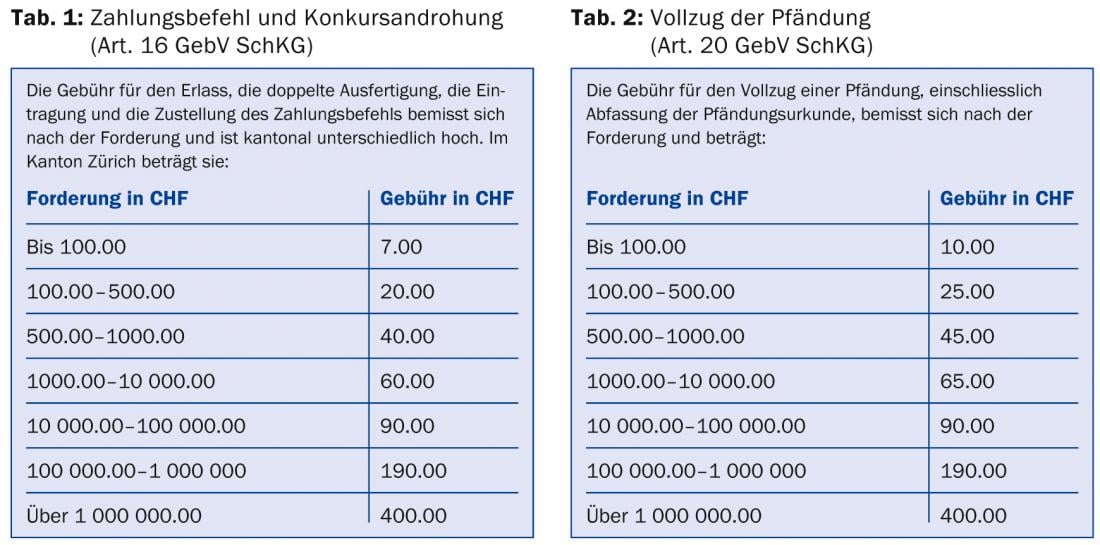
The debt collection fees can be reclaimed in the course of the proceedings. If the debtor proves insolvent, the creditor loses the advance. This is also the reason why many creditors refrain from claiming smaller amounts by way of debt collection.
Upon receipt and payment of the debt collection request, the debt collection office shall issue the order for payment. It only examines whether the request is formally correct, not whether the claim made by the creditor is substantiated in terms of material law. The order for payment is therefore not an unconditional order to pay. It is the first step in the debt collection procedure and its purpose is to request the debtor to pay.

Even if the debtor knows that the claim is justified, he may oppose payment by filing a legal claim. There are many debtors who want to buy time in this way. Experience shows that when debtors have been playing for time and find that creditors are insisting on their claim, they often relent and pay. 

Legal opening

As long as the legal proposal exists, the debt collection proceedings are at a standstill. The creditor must approach the judge within one year to remove the legal proposal. For this purpose, the creditor must submit evidence. Claims arising from medical fee invoices are regularly brought before the cantonal courts in the “ordinary course of proceedings”. The judgment rendered in the civil case authorizes the creditor to demand the continuation of the debt collection without further ado.

Attachment proceedings

After successful elimination of the legal proposal, the way to continue the debt collection is open again and the actual “enforcement procedure”, the attachment, begins. Like the debt collection request, the garnishment proceedings are never conducted ex officio. The creditor must expressly request the continuation of the debt collection and again pay an advance (Tab. 2). In the garnishment proceedings, the debtor must disclose his income and asset situation. The debt collection office requires a garnishment of the attachable income and assets.

The result can also lead to a “certificate of loss” if the debtor does not have sufficient income or assets. The creditor is thus left empty-handed and all collection costs are borne by him. However, the claim is subject to a limitation period of 20 years, whereas a fee invoice is subject to a limitation period of only five years.   

Jörg Weber

HAUSARZT PRAXIS 2014; 9(3): 42-43

Publikation
  • HAUSARZT PRAXIS
Related Topics
  • accounts receivable management
  • credit rating
  • dunning
  • garnishment proceedings
  • invoice
  • operation
Previous Article
  • Benign paroxysmal positional vertigo (BPLS)

Very high cure rates are possible with correct therapy

  • Education
  • ORL
  • RX
View Post
Next Article
  • Proteinuria

What clarifications and therapeutic measures are to be taken?

  • Cardiology
  • Education
  • Endocrinology and Diabetology
  • Nephrology
  • RX
  • Urology
View Post
You May Also Like
View Post
  • 7 min
  • Plastic surgery and reconstructive microsurgery for DFS

Functional limb preservation between infection control, vascular medicine and resurfacing

    • Angiology
    • CME continuing education
    • Endocrinology and Diabetology
    • General Internal Medicine
    • Geriatrics
    • Physical medicine and rehabilitation
    • RX
    • Surgery
View Post
  • 14 min
  • Adrenogenital syndrome

Clinical care from birth to adulthood

    • CME continuing education
    • Endocrinology and Diabetology
    • Nephrology
    • Pediatrics
    • RX
    • Studies
View Post
  • 14 min
  • New approvals, current study data and ADC development

Antibody-drug conjugates in gynecologic oncology

    • Education
    • Gynecology
    • Oncology
    • RX
    • Studies
View Post
  • 5 min
  • From symptom to diagnosis

Pneumology – Covid-19: a review

    • Cases
    • Education
    • Infectiology
    • Pneumology
    • Prevention and health care
    • Radiology
    • RX
View Post
  • 6 min
  • Abdominal aortic aneurysms in primary care

Risk-stratified screening and prophylaxis

    • Angiology
    • Congress Reports
    • Prevention and health care
    • Radiology
    • RX
    • Studies
    • Surgery
View Post
  • 9 min
  • Cardiology

Minimally invasive – the quiet triumph of modern heart surgery

    • Cardiology
    • CME continuing education
    • RX
    • Studies
    • Surgery
View Post
  • 6 min
  • Age-related neurocognitive disorders

Neuroprotective effects of Ginkgo biloba extract

    • Education
    • Geriatrics
    • Neurology
    • Pharmaceutical medicine
    • Phytotherapy
    • RX
    • Studies
View Post
  • 6 min
    • Education
    • Endocrinology and Diabetology
    • Pneumology
    • Psychiatry and psychotherapy
    • RX
    • Studies

How origin and place of residence promote CF-associated diabetes

  • IBD matters

    Zum Thema
Top CME content
  • 1
    Functional limb preservation between infection control, vascular medicine and resurfacing
  • 2
    Minimally invasive – the quiet triumph of modern heart surgery
  • 3
    HPV prevention, screening innovation and sentinel lymph node biopsy
  • 4
    Clinical care from birth to adulthood
  • 5
    Multidisciplinary teams in oncology

Newsletter

Sign up and stay up to date

Subscribe
Medizinonline Medizinonline
  • Contact
  • General terms and conditions
  • Imprint

Input your search keywords and press Enter.